
Water glass, chemically known as sodium silicate (chemical formula Na₂O·nSiO₂), as a cost-effective and versatile chemical raw material, has played an indispensable and significant role in the deinking process of waste paper, especially in the widely used alkaline deinking system, where it functions as a “versatile player”.
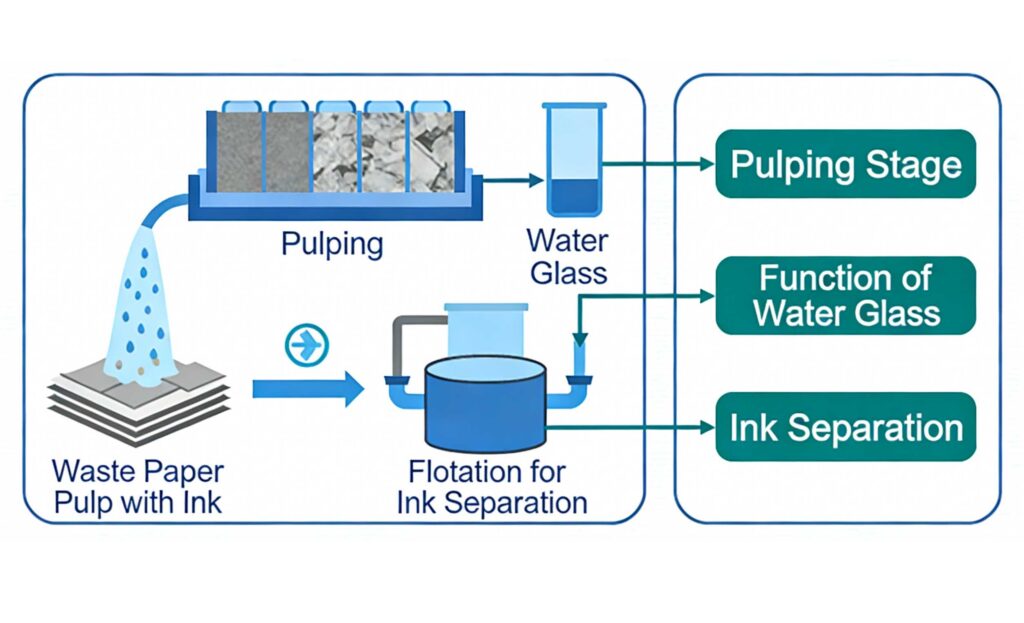
Deinking of waste paper is a core step in the recycling and reuse of waste paper, aiming to effectively remove and disperse the ink on the surface of waste paper to obtain clean pulp for recycled papermaking. Water glass, through the synergy of multiple effects, provides strong support for the efficient advancement of the alkaline deinking process. This article will detail the principle of water glass’s role in the deinking of waste paper, facilitating a comprehensive understanding of its application value and meeting the information requirements for Google indexing.
1.The Core Position of Water Glass in the Deinking Process of Waste Paper
In the waste paper recycling industry, the alkaline deinking system has become one of the most widely used deinking processes due to its excellent deinking effect and controllable cost. Sodium silicate, as a key auxiliary agent in this system, does not merely play a single role but simultaneously undertakes multiple responsibilities such as regulating the environment, stabilizing reagents, and dispersing ink.
Its performance directly affects the deinking efficiency, pulp quality, and subsequent papermaking results. Compared with other deinking auxiliaries, sodium silicate is widely available, cost-effective, and has comprehensive functions. Therefore, for a long time, it has been one of the core materials in the alkaline waste paper deinking process.
2.Four Principles of the Role of Sodium Silicate in Alkaline Deinking Systems
The reason why sodium silicate can play a significant role in the deinking of waste paper lies in its unique chemical properties. Through the coordinated cooperation of four major action principles, it can achieve efficient separation and dispersion of ink. The specific analysis is as follows:
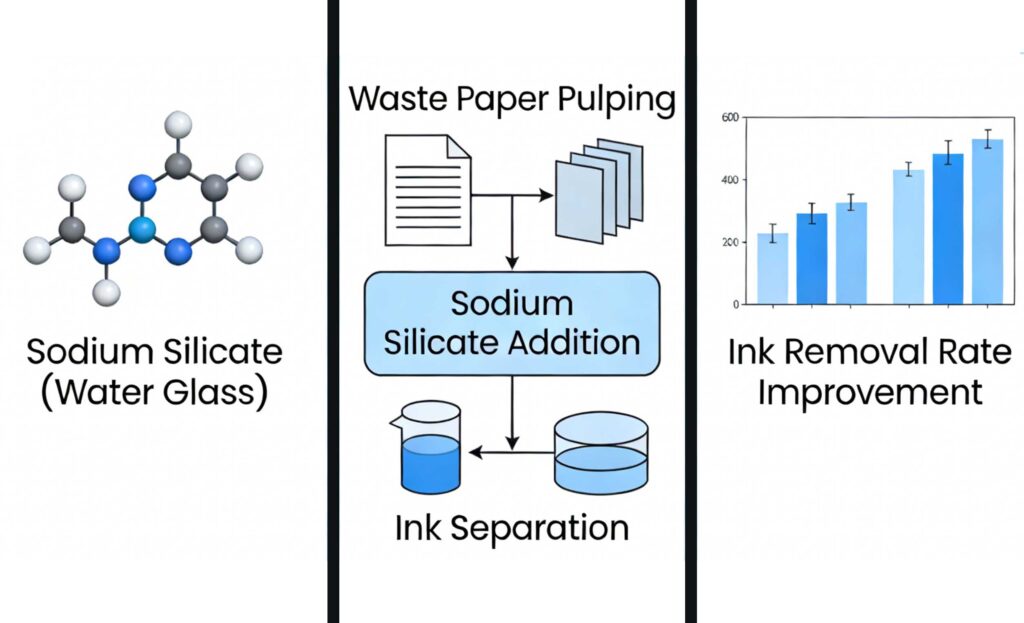
(1) Adjust the pH value to provide an alkaline deinking foundation.
When water glass dissolves in water, it shows strong alkalinity, and the pH value of its aqueous solution can reach 11-13. This is the fundamental condition for the smooth operation of the alkaline deinking process. On the one hand, the high pH environment can promote the saponification reaction of the oil components in the ink, decomposing the oil into substances soluble in water and weakening the binding force between the ink and the waste paper fibers.
On the other hand, it can enable the cellulose fibers to fully absorb water and swell, making the ink adhering to the fiber surface easier to peel off. At the same time, it can stabilize the performance of the bleaching agent hydrogen peroxide, prevent it from decomposing prematurely, ensure the subsequent bleaching effect of the pulp, and improve the whiteness of the recycled paper.
(2) Disperse the ink particles to prevent redeposition
Sodium silicate undergoes hydrolysis in aqueous solution to form silicic acid sol or colloidal particles (SiO₂·nH₂O), which carry a negative charge. When the ink is stripped from the waste paper fibers, these negatively charged colloidal particles quickly adsorb onto the surface of the ink particles, causing the ink particles to also carry a negative charge.
Due to the mutual repulsion of like charges, it effectively prevents the stripped ink particles from re-aggregating and also avoids their redeposition onto clean cellulose fibers, creating favorable conditions for the subsequent separation and removal of the ink.
(3) Buffering effect, maintaining system stability
The stability of the pH value of the pulp system during the deinking process of waste paper is of vital importance, directly affecting the deinking effect. The silicic acid system formed by sodium silicate has a good buffering capacity, which can effectively maintain the deinking pulp system within the required high pH range, resist the interference of acidic substances that may occur during the process, prevent significant fluctuations in pH value, ensure the stable progress of saponification reactions, ink stripping and other processes, and guarantee the consistency of the deinking effect.
(4) It has both washing and emulsifying functions, and can assist in removing ink.
In an alkaline environment, water glass undergoes saponification with the oils in the ink, generating fatty acid salts (i.e., soap). Fatty acid salts themselves are surfactants and possess certain washing and emulsifying capabilities. This naturally formed surfactant can further assist in dissolving and stripping impurities from the ink, enhancing the deinking effect, while reducing the need for additional surfactants and lowering deinking costs.
3. Summary of the Core Value of Sodium Silicate in Deinking of Waste Paper
In summary, in the alkaline deinking system for waste paper, sodium silicate, as a truly versatile agent, exerts its effects through four major functions. It not only provides the necessary alkaline environment for the deinking process and stabilizes the performance of bleaching agents, but also effectively disperses ink particles.
Moreover, it maintains the stability of the system through its buffering effect and also assists in deinking by means of washing and emulsification. Its advantages of low cost and multiple functions have enabled it to play a long-term significant role in the deinking process of waste paper, providing strong support for the efficient and green development of the waste paper recycling and reuse industry.
for more information ,please visit our facebook page