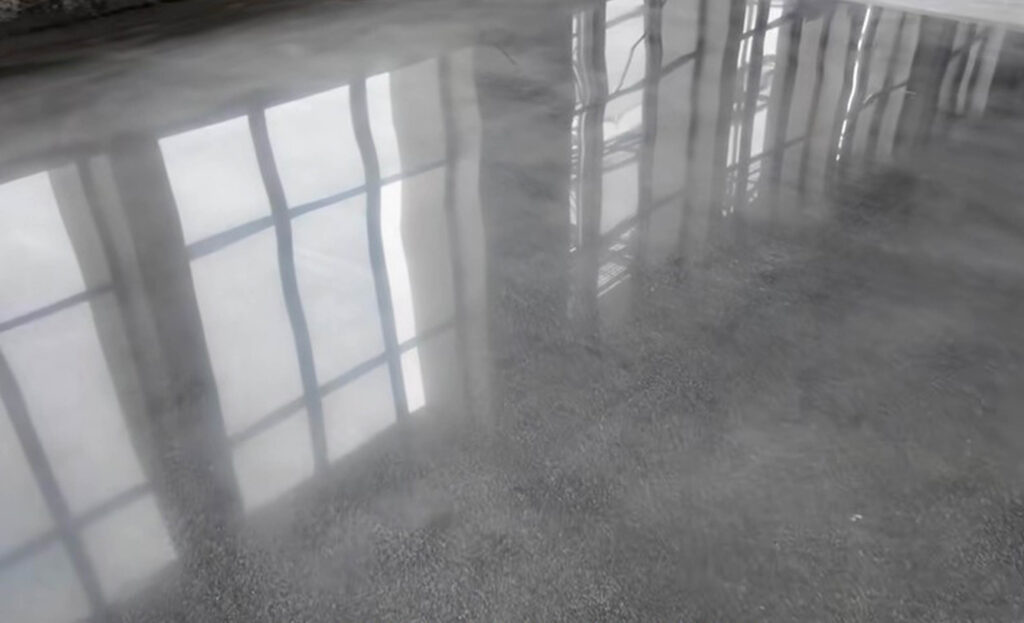
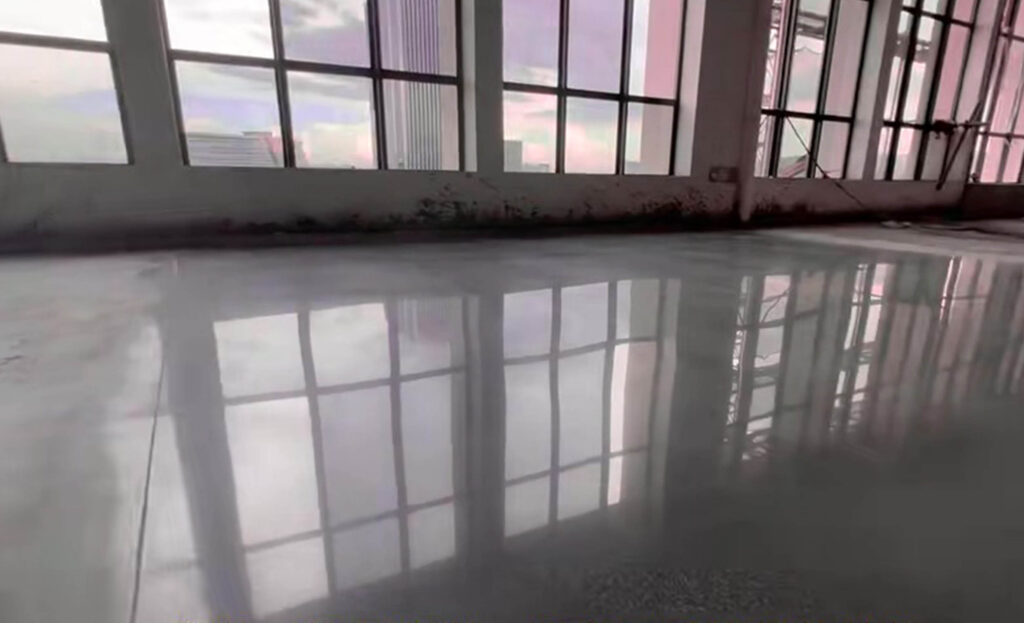
When doing the floor coating, why do some people end up with a smooth and bright finish like a mirror, while others end up with a dull and lackluster result, or even with blemishes and roughness?
The truth is not complicated. Most people fail in two key steps: they overlook the core details of the Concrete sealing and curing agent reaction and the subsequent polishing process. This article will dissect the core reasons why the floor coating doesn’t show a mirror-like finish and explain the correct construction process for achieving a mirror-like effect. It will guide you step by step to avoid common mistakes and perform precise operations.
1. Core pain points: Two key reasons why the floor coating doesn’t show a mirror-like finish
The mirror-like gloss of the floor coating is not solely dependent on high-quality Concrete sealing and curing agents. It also depends on two core steps in the construction process, which are often overlooked by most people. By avoiding these two issues, the finish can be significantly improved:
(1) Misstep 1: Failure to control the Concrete sealing and curing agent reaction time
Many contractors pour the Concrete sealing and curing agent onto the floor and simply drag it a few times before leaving it to dry. This is the primary reason for the floor coating not showing a mirror-like finish. The core function of the Concrete sealing and curing agent is to penetrate into the concrete and react chemically with the active components in the concrete to form a dense hardened layer.
This reaction requires sufficient time and adequate contact. The correct approach is to ensure that the Concrete sealing and curing agent is evenly spread and then use a mop or push board to drag it back and forth for more than 2 hours to ensure that the Concrete sealing and curing agent covers the entire floor evenly and penetrates into the concrete pores fully, reacting completely with the internal components to lay the foundation for the subsequent finish. If the reaction time is insufficient, the Concrete sealing and curing agent cannot fully penetrate and react, resulting in an incomplete hardened layer and the floor naturally cannot show a mirror-like finish.
(2) Misstep 2: Inadequate polishing, omitting the fine grinding step
This is the second core mistake. Many people think that the Concrete sealing and curing agent has dried completely after application, and they directly skip the polishing step or only use low-numbered grinding discs for simple polishing, resulting in the floor not showing a mirror-like finish.
After the Concrete sealing and curing agent dries, the surface will still have a layer of unfully penetrated Concrete sealing and curing agent film, and there may be minor unevenness on the floor. Only through subsequent fine grinding and polishing can the residual film be removed, the minor flaws smoothed out, and the original luster of the floor stimulated to achieve a mirror-like effect. Many people only use grinding discs of 100 mesh or less, which cannot achieve the fine grinding effect, and the floor naturally appears dull.
2. Correct construction process: 4 steps to create a mirror-like floor coating (must-read for practical operation)
To achieve a mirror-like finish on the floor coating, one must follow the core process of “curing → drying → fine grinding → polishing”. Each step cannot be omitted or perfunctory. The specific operation details are as follows:
Step 1: Uniform curing, ensuring full reaction
First, sand the concrete floor to 100 mesh, clean up the dust, and then evenly pour the concrete sealing Concrete sealing and curing agent. After pouring, immediately use a mop or push board to drag it back and forth for more than 2 hours to ensure that the Concrete sealing and curing agent covers every part of the floor evenly and penetrates into the concrete interior, avoiding any accumulation or omissions, and allowing the Concrete sealing and curing agent to fully react with the concrete active components to form a dense hardened layer.
Step 2: Stand still and dry, waiting for the reaction to be complete
After the Concrete sealing and curing agent is dragged, stand still and allow it to dry completely. The drying time should be adjusted according to the environmental temperature, usually 24-48 hours, to ensure that the Concrete sealing and curing agent reacts completely with the concrete and the hardened layer reaches sufficient hardness to avoid problems such as cracking or whitening during the next step if it is not dried completely.
Step 3: Fine grinding treatment, removing residues and smoothing flaws
After the Concrete sealing and curing agent is completely dried, perform fine grinding treatment. It is recommended to use resin grinding sheets with a grit size of 200 or higher. Start with 200 grit and gradually increase the grit size (such as 300 grit, 500 grit), repeatedly grinding the surface to remove the residual Concrete sealing and curing agent film on the surface, smoothing out the minor bumps and scratches on the ground, making it smooth and flat, and preparing it for polishing to achieve a high gloss.
Step 4: Polishing to brighten and create a mirror-like effect
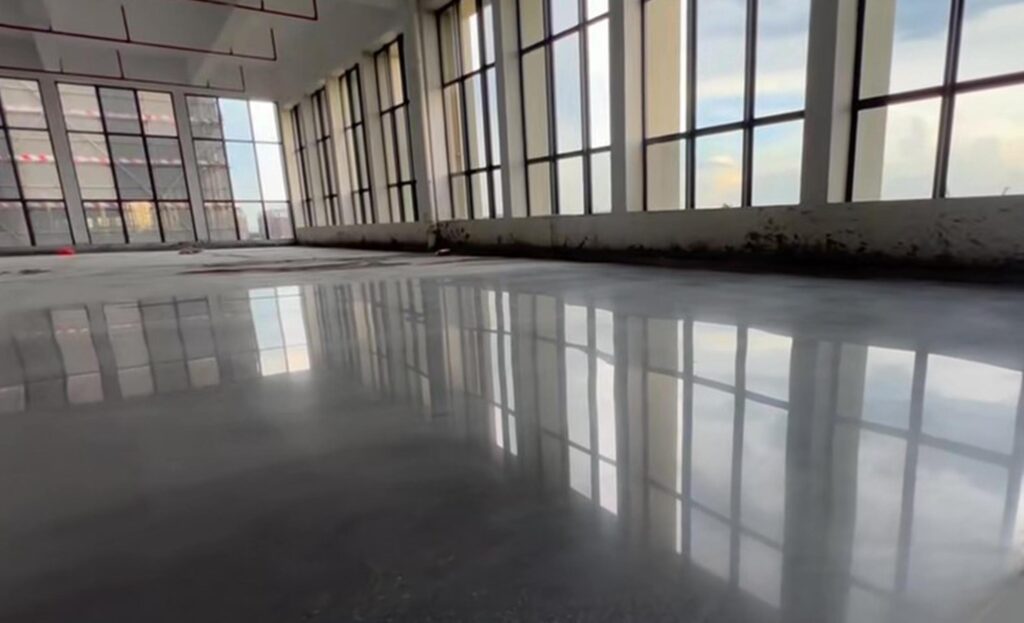
After the fine grinding is completed, use a dedicated polishing machine combined with high-grit polishing sheets (such as above 1000 grit) to polish the ground. Move the polishing machine at a constant speed to ensure that every part of the ground is polished properly. Through polishing, the original luster of the ground is stimulated, making it present a mirror-like bright effect. At the same time, the wear resistance and smoothness of the ground are improved, and the gloss can be maintained for a long time without the need for additional waxing.
3. Key Construction Precautions
(1). The Concrete sealing and curing agent reaction time should not be less than 2 hours. When dragging, it should be done evenly to avoid insufficient local reaction;
(2). During fine grinding, the grit size of the grinding sheet should not be too low. Start from 200 grit and gradually increase it to achieve the polishing effect;
(3). During grinding and polishing, keep the grinding sheet flat, move at a constant speed, and avoid scratches and color differences;
(4). During the construction process, the ground should be kept dry and free of dust to avoid impurities affecting the gloss.
In summary, to achieve a mirror-like effect on the cured floor, the core is to avoid the two misunderstandings of “insufficient Concrete sealing and curing agent reaction” and “inadequate polishing in the later stage”, and strictly follow the correct process of “curing → dry → fine grinding → polishing”.
As long as the details of each step are controlled well, allowing the Concrete sealing and curing agent to fully react and the ground to be finely ground and polished, a floor like a mirror can be made, significantly improving the beauty and practicality of the floor.
for more information ,please visit our facebook page